
SmartPlay Workshop for Coaches and Sports Professionals in Slovenia
As part of the international project SmartPlay – AI-Powered Solutions to Prevent Dropout in Girls’ Basketball, Institute IMPACT organised a workshop for coaches and sports professionals on 10 September 2026. The workshop was held within the framework of the Seminar for Youth Team Coaches, in cooperation with the Slovenian Basketball Coaches Association.
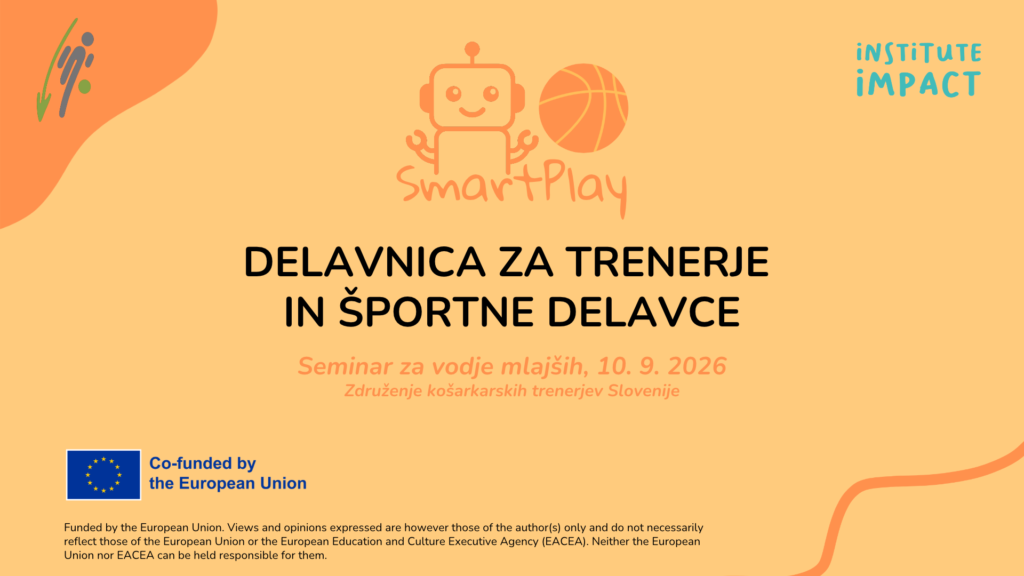
The workshop introduced the SmartPlay project and practical approaches that can help coaches and sports organisations better understand and identify, at an early stage, the factors contributing to young people dropping out of sport, particularly girls, as well as how artificial intelligence can be used in this process. The SmartPlay project develops innovative methods that combine coaches’ expertise, psychological support, and the meaningful and responsible use of artificial intelligence. Particular emphasis is placed on the fact that technology should support coaches in their work, but should never replace their professional knowledge, experience, empathy, or relationships with athletes.
Participants learned about factors that may indicate an increased risk of dropping out of sport, such as more frequent absences, reduced motivation, lower engagement in training, withdrawal from the team, decreased self-confidence, and changes in behaviour. An approach was presented in which artificial intelligence can help combine information on attendance, engagement, feedback, and coaches’ observations, and identify relevant patterns. However, the final assessment and decision on the appropriate course of action always remain with the coach. An important part of the workshop was also dedicated to an individualised approach to coaching. Based on observations and feedback, coaches can adapt the intensity and content of training, communication methods, motivational approaches, and athletes’ individual goals. The aim is not only to improve sports performance, but also to strengthen long-term motivation, well-being, and young people’s willingness to remain involved in sport.
Practical SmartPlay tools for the everyday work of coaches and clubs were also presented, including an attendance and dropout-risk checklist, an athlete profile card, weekly coach self-reflection, short athlete check-ins, and an action plan for athletes at increased risk of dropping out. The purpose of these tools is to encourage a shift from a reactive to a more proactive approach: observe – identify – act – monitor. Particular attention was also given to creating a safe, inclusive, and supportive sports environment in which young people feel accepted, heard, respected, and included. Coaches have an important role in building a positive team culture, encouraging cooperation, involving athletes in decision-making, and responding promptly to exclusion, discrimination, or peer bullying. Participants also learned about the importance of high-quality communication with athletes and parents. Rather than making assumptions about the reasons behind reduced motivation, SmartPlay encourages coaches to ask, listen, and work together with the athlete to find appropriate solutions. Trust is built through regular communication, active listening, constructive feedback, and clear relationships and expectations between the athlete, coach, and parents.
The workshop also addressed the responsible and ethical use of artificial intelligence in sport. When working with young people, particular care must be taken when handling personal data. Only data that are genuinely needed should be collected, appropriate consent must be obtained, data must be stored securely, and bias and labelling of individuals must be avoided. A key principle of SmartPlay is that the human being always remains responsible for the final decision, not the technology.
In the next phases of the project, SmartPlay will develop an interactive e-learning platform with 11 thematic modules, organise additional training sessions for coaches and sports professionals, test the developed approaches in real sports environments, and conduct workshops for young female athletes. The overall objective is to provide coaches and sports clubs with practical, accessible, and user-friendly tools that enable earlier identification of dropout risk and timely support for young female and male athletes.
The key message of the workshop was clear: technology can help detect change, but relationships, trust, and high-quality coaching are what help young people stay in sport. Continuous professional development for coaches, together with the exchange of knowledge and good practices, therefore remains an important part of developing a high-quality sports environment.